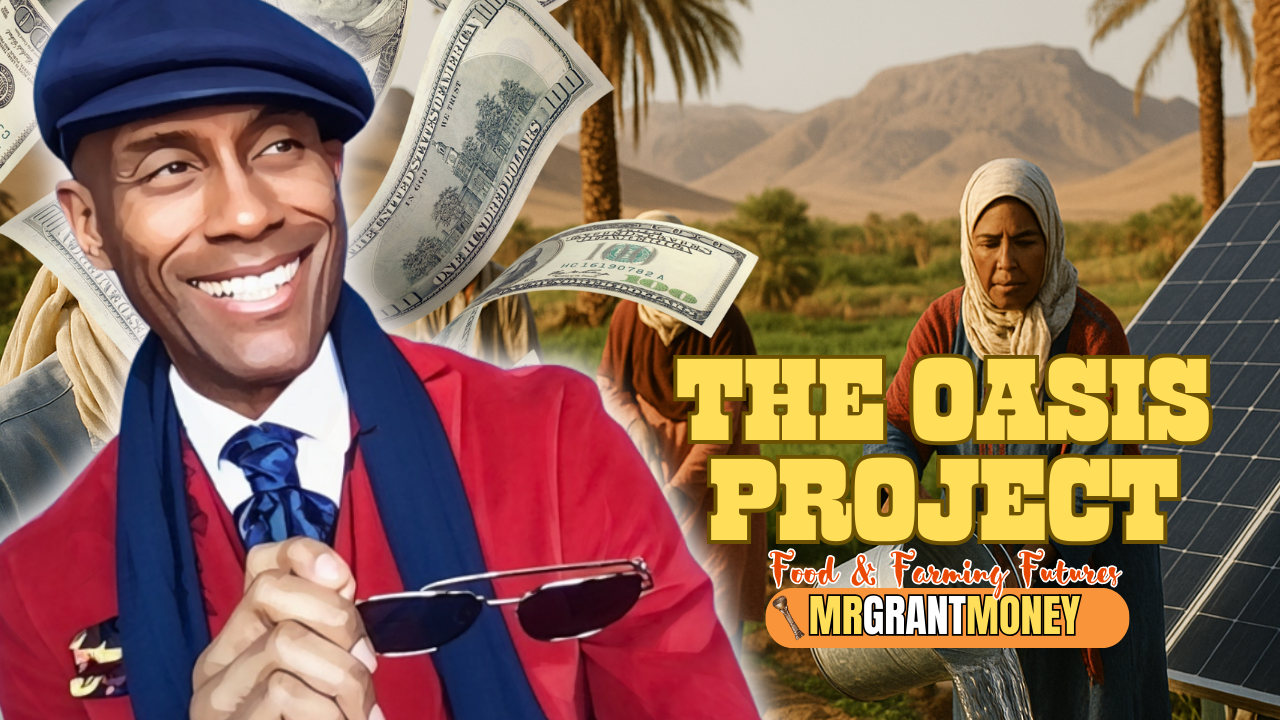
The Oasis Project: Mr. Grant Money & the Desert Farming Network in Tunisia
 Wed, Nov 19
Water, Wisdom & the Oasis Rebellion: Mr. Grant Money & the Desert Farming Network in Tunisia
⏳ “You’ve got 90 days of water left. Maybe less.”
That was the warning from the regional ministry official to the elders of Ksar Ouled Soltane, a centuries-old oasis town at the edge of Tunisia’s vast desert.
Ninety days. That’s how long they had before the date palms withered, the communal well ran dry, and the last of the ancestral gardens turned to dust. The aquifers were receding, the sandstorms were growing bolder, and climate reports told a story no one wanted to hear: North Africa was running out of time.
And yet—under a crescent moon and the crackle of a shared radio—a plan was already sprouting in the minds of a crew of desert rebels, seed-savers, solar engineers, and stubborn farmers who refused to let their land, their food, or their future die without a fight.
That plan? It would be called The Oasis Project. And the moment I heard about it, I knew it needed firepower. The kind that comes in kilowatts and climate-driven grant acquisition.
When the Earth Cracks and the Fridge Is Empty
In Tunisia’s southern governorates, the ground has always been dry. But now it’s brittle. Once-fertile oases that produced figs, dates, olives, and barley for generations are now shrinking at alarming rates.
Meanwhile, imported food—processed, expensive, nutritionally hollow—is flooding in. Supermarket prices soar. Traditional diets collapse. Diabetes and malnutrition creep into even the smallest villages. Youth flee to the cities or risk the dangerous Mediterranean crossing in search of opportunity.
This isn’t just about drought. This is a collapse of food culture, local economy, and generational food literacy. The oases were never just sources of food—they were living testaments to survival, adaptation, and intergenerational genius.
And now? That genius was being buried under sand and bureaucracy.
But not if the farmers had anything to say about it.
The Desert Crew That Wouldn’t Quit
The Desert Farming Network is a coalition of farmers, herders, grandmothers, and ex-agribusiness dropouts who had one thing in common: they believed the desert could bloom—again.
There’s Nadia, an agroecologist who left a cushy EU post to return to her grandfather’s land and experiment with vertical drip farming. Mourad, a solar tech from Tataouine who designed a gravity-fed irrigation system using repurposed plastic barrels and salvaged tubing. Amine, the 72-year-old date palm whisperer who claims he can tell soil pH by smell. And Leïla, an outspoken teen activist documenting the fight on TikTok—an echo of youth entrepreneurship rooted in soil, not screens.
Together, they drafted a bold vision: restore the oasis as a climate-resilient food and water hub using ancestral knowledge and cutting-edge innovation. A hybrid model of regenerative desert farming, seed sovereignty, and renewable energy.
The blueprint was solid. The urgency was real. But as always, the money was missing.
Mr. Grant Money Rolls into the Dust
When I got the call, I was halfway through writing a proposal for a vertical farm in Detroit.
“Tunisia?” I asked. “How bad is it?”
“Think: 90 days of water left,” Nadia said. “We’re past the tipping point.”
I flew in with dust goggles, grant leads bookmarked, and a deep respect for people who could farm in 110°F without air conditioning.
My first impression? This wasn’t a project—it was a movement. A philanthropy-fueled climate rebellion. And they weren’t asking for permission. They were asking for strategy.
So I opened my playbook and we got to work.
How We Wrote the Proposal That Made Donors Sweat
We mapped the stackable grants that could turn this dream into a funded future:
-
FAO Dryland Innovation Fund (community-led ag restoration)
-
Green Climate Fund Pilot for MENA Resilience
-
AgriSolar Small Systems Innovation Grant
-
UNDP Local Climate Adaptation Block Grant
-
A private foundation focused on youth entrepreneurship in arid regions
But more important than the grants was the storytelling strategy—because funders don’t just fund data. They fund belief.
🌀 We didn’t pitch “emergency relief.” We pitched regenerative sovereignty.
🌀 We revived ancient water practices that outperformed imported tech.
🌀 We monetized carbon sequestration data from permaculture systems.
🌀 We highlighted youth-led media and tech tracking to attract next-gen funders.
We called it: “From Dust We Rise: A Desert Sovereignty Model for the 22nd Century.”
What the Money Grew in the Desert
Then the funding rained down:
💧 $500K from UNDP
🌞 $250K from FAO
🔌 $100K in solar pump grants
🎥 $70K from a French social impact investor, inspired by Leïla’s TikTok reel
And with it, the desert responded.
🌿 Over 10,000 native trees planted
🚰 Two ancient cisterns revived with solar desalination
🌾 A Desert Seed Bank with 47 heirloom varietals
🧑🏽🍳 Traveling “Oasis Kitchens” led by grandmothers, feeding students wisdom and bread
📱 An SMS-based soil-monitoring tool for farmers using secondhand phones
Grant Money’s Oasis Playbook: Lessons from the Sand
📍 “The future isn’t vertical farms. It’s ancient ones, restored.”
📍 “Water scarcity is funding scarcity in disguise.”
📍 “Sovereignty begins with seeds, not satellites.”
📍 “Frame your struggle as a climate solution, not a climate crisis.”
📍 “Youth media is a funding magnet—use it.”
Want to learn how to build your own strategy like this? Head to Mr. Grant Money's Store or browse more rebel blueprints at the Mr. Grant Money Blog.
💬 Discussion Questions
-
What climate solutions already exist in your community’s past?
-
How can youth voices help funders see urgency and innovation?
-
Where are you being told to “adapt” when you should be funded to lead?
-
What would food sovereignty look like in an arid, post-oil future?
-
How can global grants honor hyperlocal genius—without extraction?
🔓 UNLOCK EXCLUSIVE TIPS WITH MR. GRANT MONEY!
We hate SPAM. We will never sell your information, for any reason.