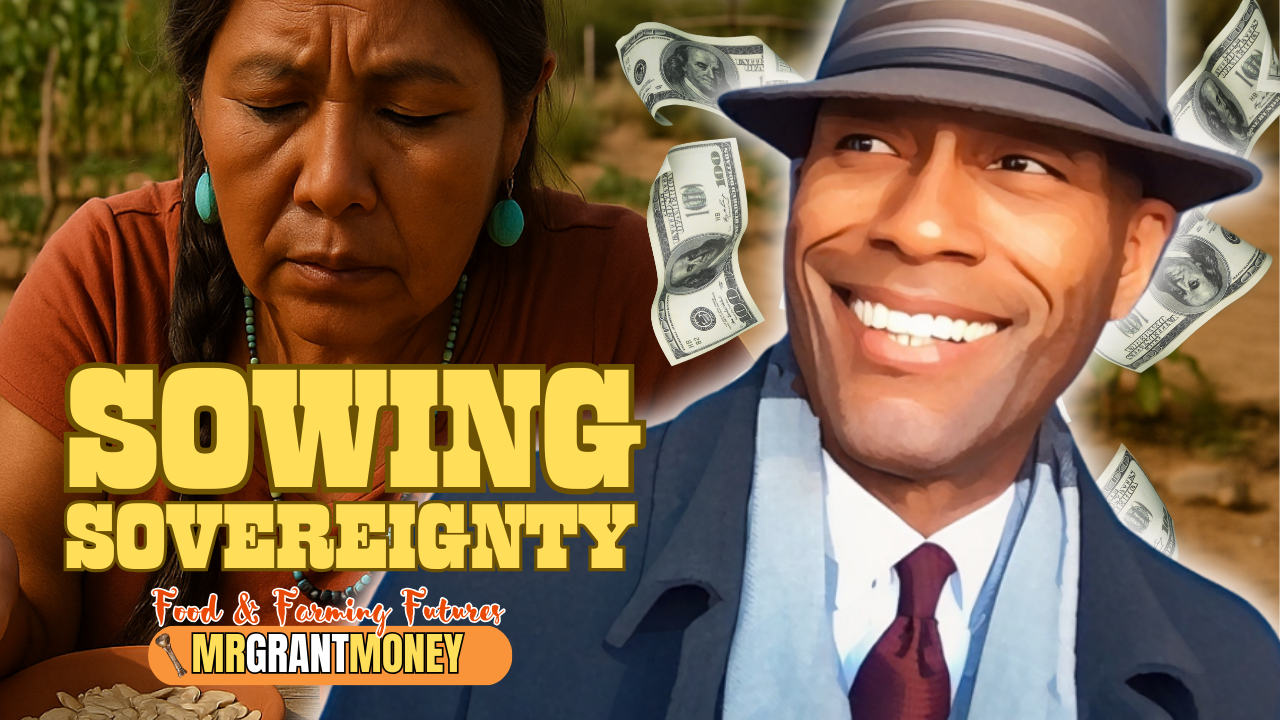
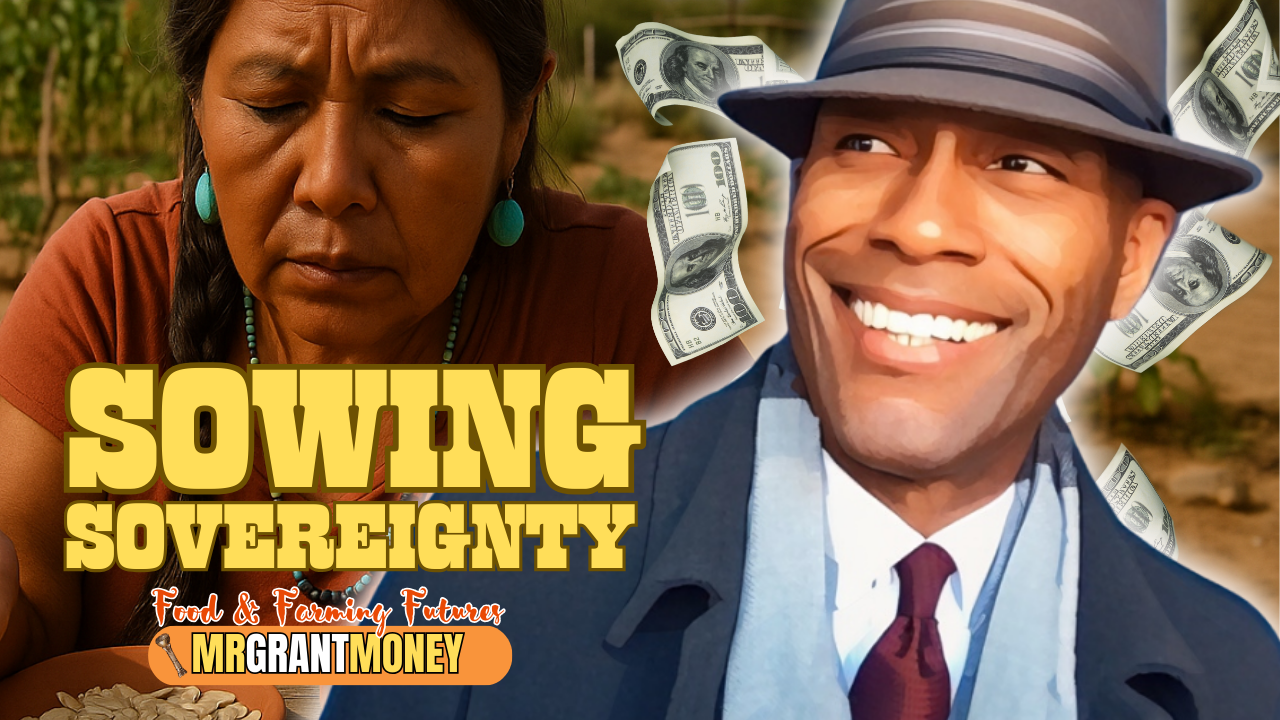
Sowing Sovereignty: Mr. Grant Money & the Indigenous Seed Keepers of Arizona
 Mon, Nov 24
What do you do when your grandmother’s garden is gone—and your child doesn’t know what real food tastes like?
That’s the question Leona asked herself as she stared at a shelf of beige government-issued commodity cans, none of which she remembered from her own childhood. She missed the smell of roasted blue corn, the stories told over squash stew, the way her grandma would pat the earth before she planted—like a prayer.
Now the ground behind her house was dry. Her son thought food came in plastic. And her tribe had the highest rate of kidney failure in the state.
“Something sacred is missing,” she whispered. And that’s when she remembered the jar.
A mason jar, cracked and dusty, buried in the back of her pantry. Inside: five shriveled, wrinkled seeds. Labeled in faded marker: “Akimel O’odham melon – do not lose.”
That was the moment. Not a protest, not a meeting—just a kitchen. A mother. A handful of hope.
The Quiet Starvation No One Talks About
In Northern and Central Arizona, Indigenous communities are surrounded by ancestral lands—but cut off from ancestral nourishment.
Water has been diverted. Soil poisoned. Supermarkets abandoned their communities years ago. Replaced by dollar stores, fast food, and federal rations that offer salt but no sustenance.
This isn’t just about hunger. It’s about identity erosion. It’s about kids growing up thinking “traditional food” means fry bread from a truck, not the ancient beans that fueled generations of warriors and healers.
For decades, food systems were weaponized to suppress sovereignty. Now those same communities are choosing to fight back—with seeds, soil, and science. And with partners like Mr. Grant Money, they’re finding ways to reclaim their narrative.
The Aunties with Seeds and Smoke in Their Hands
Leona wasn’t alone. All across the tribal nations of Arizona, people were holding onto fragments: seed bundles in freezers, songs remembered in dreams, recipes scrawled on the backs of electric bills.
They began to gather—first at a borrowed community center, then under ramadas, then in each other’s homes. Farmers. Aunties. Medicine women. Youth who didn’t know the taste of their ancestors’ crops but were hungry to learn.
They called themselves the Indigenous Seed Keepers of the Sonoran Basin. Not an org. A movement.
Their mission? Reclaim, restore, and replant the seeds that colonization, climate collapse, and capitalism tried to erase. But they didn’t want a garden project. They wanted a sovereignty system—rooted in financial literacy, intergenerational education, and food as infrastructure.
Mr. Grant Money Meets the Desert Guardians
I showed up during the first monsoon. My boots stuck in the clay. My notes got soaked. But I stayed, because I saw something you can’t unsee:
A 9-year-old girl learning to plant corn using her grandmother’s method—no irrigation, just prayers and moonlight.
A circle of teens learning to grind blue corn on a metate older than their school building.
An elder standing by a scorched field, whispering to a squash seed like it was her grandchild.
This was more than food justice. This was a resistance movement disguised as agriculture.
They didn’t ask for help. They asked for partnership. And I said yes—to build a grant acquisition strategy that honored their sovereignty.
How We Built the Proposal Like a War Drum
We didn’t write for pity. We wrote for power.
The proposal told the story of a people who refused to disappear—whose seeds carried stories, whose soil remembered songs.
We included data—yes: tribal health metrics, food insecurity maps, climate stress indicators. But we wrapped every number in a narrative.
We called it: Sowing Sovereignty: A Seed-to-Freedom Blueprint for Indigenous Arizona.
And we broke every grantwriting “rule” in the book.
We started the proposal with Leona’s story. We listed heirloom crops as “strategic assets.” We attached a map of all tribal gardens within a 150-mile radius and called it the “Desert Resistance Belt.”
We didn’t ask for charity. We made the case for investment—in climate survival, public health, food security, and Indigenous genius. A model rooted in philanthropy, not pity.
The Day the Seeds Came Home
The first check came from the USDA’s Tribal Food Sovereignty Fund. Then a climate resilience grant from a national conservation org. Then tech partners showed up with microclimate monitoring systems—on the condition that all data stayed within tribal control.
By the time the second monsoon rolled around, the transformation had begun.
Vacant lots turned into seed sanctuaries. School lunch menus included traditional beans, amaranth, and heritage squash. Grandparents and teens harvested together. And mobile seed labs—basically greenhouses on wheels—rolled out to the most remote corners of the reservations.
The community called it “the seed rebellion.”
They weren’t just planting. They were returning. And they were building a future that embraced both entrepreneurship and cultural preservation.
What I Learned in the Dust
If you’re looking to fund the future, don’t just follow the clean reports. Follow the cracked hands. Follow the aunties. Follow the seeds.
Here’s what I took away from Arizona:
-
Seeds hold more than food—they hold memory.
Treat them like sacred infrastructure. Protect them legally, culturally, and politically. -
You can’t fix centuries of extraction with a five-year grant.
Build long-term models. Fund with patience. Grow with purpose. -
Youth don’t need saving—they need soil.
When they plant what their ancestors grew, they stop seeing themselves as broken. They start seeing themselves as legacy. -
Don’t water down the story.
Use data, but let the truth hit like thunder. Let the funder feel the drought and the first drop of rain. -
Food is sovereignty.
If you’re not funding food systems that center land, lineage, and liberation—you’re just rearranging the shelves on a sinking grocery store.
💬 Reflection Questions for the Movement Builders
- Who in your family or community still holds seed stories—and how are you honoring them?
- What would your neighborhood look like if it treated food as sacred, not a product?
- Are we funding innovation—or forgetting that our ancestors already had the answers?
- How do we write grants that feel like storytelling, not selling out?
- What seeds—literal or metaphorical—do you need to return home?
🔓 UNLOCK EXCLUSIVE TIPS WITH MR. GRANT MONEY!
We hate SPAM. We will never sell your information, for any reason.